Published: November 15, 2026
Your Company Has More Intelligence Than Any Executive Can Process.So Why Are We Still Guessing?
Why the next competitive advantage will come from building an organizational brain that connects intelligence, strategy, and execution.
Imagine you are the CEO of a $50 million software company. Growth has slowed, the board expects a turnaround, and you have 90 days to show the business is moving in the right direction.
You bring your leadership team together. Your CRO believes you need more pipeline. Your CMO wants better positioning and more investment in demand generation. Your product leader believes you are losing deals because of missing capabilities. Your customer success leader believes customers are not realizing enough value. Your CFO wants greater operational efficiency.
Everyone comes prepared with data, a reasonable argument, and a proposed solution. Everyone may be right about their part of the business.
But who is right about the business as a whole? And how do you determine which decisions will have the greatest impact over the next 90 days?
This is one of the most difficult problems in executive leadership. It is also one of the most interesting opportunities I see for enterprise AI.
The Human Limitation We Rarely Acknowledge
Over the past thirty years, I have worked across sales, marketing, product management, enterprise technology, business strategy, and executive leadership. From large organizations like Microsoft to smaller, faster-moving software companies, I have encountered a recurring problem: organizations accumulate more intelligence than any individual can realistically consume.
Consider everything an executive team needs to understand to make a sound growth decision:
- Product capabilities, differentiation, adoption, and roadmap
- Customer needs, buying behavior, and evolving expectations
- Market dynamics and competitive positioning
- Pricing, packaging, and willingness to pay
- Sales performance and pipeline conversion
- Marketing effectiveness and acquisition economics
- Partner and channel performance
- Customer retention, expansion, and profitability
And that is before considering the relationships between these variables. A pricing decision can affect channel economics. A positioning problem can look like a sales execution problem. A product adoption issue can become a renewal problem. A poorly defined ideal customer profile can undermine marketing efficiency, sales conversion, and customer retention simultaneously.
These are not independent problems. They are interconnected components of a business system. Yet we typically analyze them independently because that is how we organize our companies.
We divide the business into functions and then expect human beings to reconstruct the entire business from those individual perspectives.
That is an extraordinary intellectual challenge.
Why Smart Executives Still Make Poor Strategic Choices
When faced with complexity, uncertainty, and time pressure, we naturally simplify. We focus on the problems that are most visible, favor explanations consistent with our previous experience, gravitate toward initiatives that appear achievable, and sometimes choose the path with the least organizational or political risk.
None of this means executives are incapable of making good decisions. It means human judgment operates within real constraints.
If revenue is below target, hiring more salespeople might seem the obvious response. If customers are unhappy, accelerating the product roadmap might seem reasonable. If pipeline generation is slowing, increasing marketing spend might feel necessary. Each action can be justified, and each can also be the wrong response.
What if the real problem is that the company is targeting customers who do not have a sufficiently urgent need for its product? More salespeople will not fix that. More marketing will amplify the problem. More product features may make the offering even harder to position. The organization can spend millions of dollars addressing symptoms while leaving the underlying constraint untouched.
The most expensive strategic mistake is not choosing a bad initiative. It is choosing a reasonable initiative that solves the wrong problem.
We Do Not Have a Data Problem. We Have a Synthesis Problem.
Enterprise software has made enormous progress in collecting, organizing, and presenting information. CRM systems capture customer activity. Product analytics capture usage. Marketing platforms capture engagement. Financial systems capture business performance. Business intelligence platforms bring metrics together. AI can now summarize documents, conversations, and entire knowledge repositories.
All of this is useful. But summarizing everything an organization knows is not the same as understanding what the organization should do.
Imagine giving an executive a thousand pages of perfectly accurate summaries covering every function of the business. Have we solved the problem? Not necessarily. We may have simply reduced ten thousand pages of information to one thousand. The executive still needs to distinguish symptoms from causes, identify relationships, evaluate tradeoffs, and decide where to allocate resources.
The missing capability is synthesis: connecting seemingly unrelated pieces of evidence into a coherent understanding of the business, identifying what matters and why, and translating that understanding into a set of strategic choices. This is where I believe AI can create a fundamentally different kind of enterprise value.
What If an Organization Had a Brain?
The human brain does not function as a collection of independent dashboards. It connects memories, experiences, observations, and new information. It forms hypotheses, evaluates possibilities, helps us decide how to respond, and, ideally, learns from the consequences.
What if we could bring a similar operating principle to an organization? Imagine an intelligence layer that works across product, marketing, sales, channels, customer success, and market information. Not simply to report what each function is doing, but to help leadership understand where the business is experiencing friction, what might be causing it, and which interventions deserve the most attention.
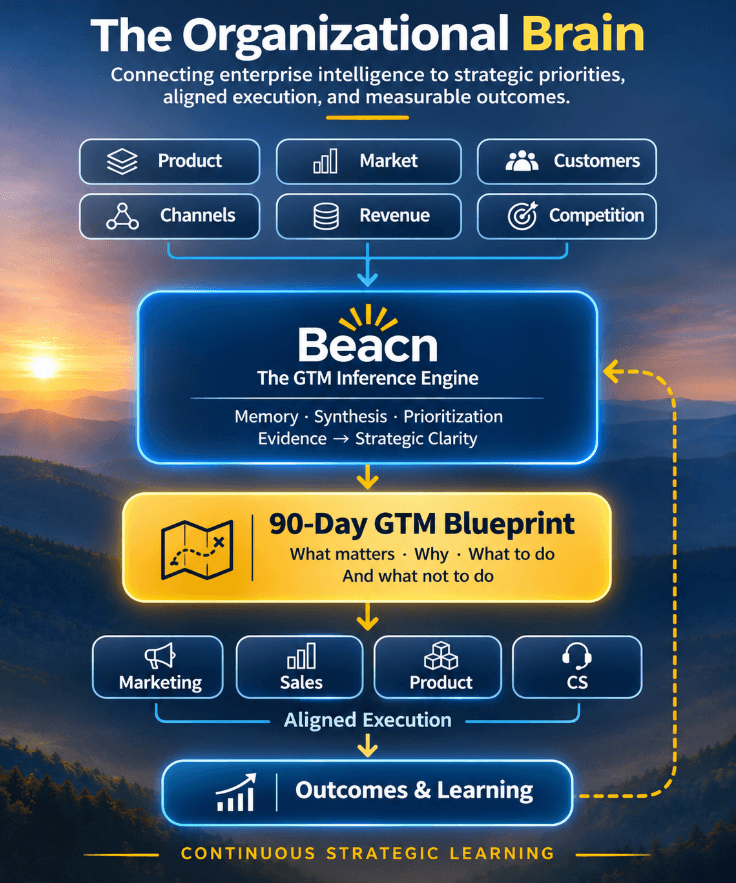
An organizational brain would need five fundamental capabilities:
- Memory: Preserve what the organization knows about its customers, markets, products, decisions, and outcomes.
- Synthesis: Connect evidence across functions and surface relationships that might otherwise be overlooked.
- Prioritization: Identify the most consequential problems and opportunities rather than produce an endless catalogue of recommendations.
- Alignment: Translate strategic choices into consistent direction for the teams responsible for execution.
- Learning: Incorporate new evidence and outcomes so that future decisions benefit from what the organization has already experienced.
The concept is not to replace the executive team. It is to give the executive team a better foundation for exercising judgment.
From Twenty Problems to Three Strategic Priorities
Let us return to our hypothetical $50 million software company. The leadership team has identified twenty potential initiatives to improve growth, spanning product investment, sales expansion, marketing, pricing, packaging, customer retention, and channel development. Traditionally, the team might spend several weeks discussing them, negotiating budgets, and deciding which to pursue.
Now imagine a different approach. An organizational intelligence system examines the available evidence across these areas and identifies three possible underlying constraints.
1. The company is targeting too broad a market
The positioning attempts to appeal to multiple customer segments with very different needs. Marketing generates interest, but much of it does not convert into meaningful buying conversations. The sales team spends considerable effort qualifying opportunities that should never have entered the pipeline.
2. The product is differentiated, but the differentiation is not reaching the buyer
The product has capabilities that matter to a particular segment. However, marketing emphasizes generic functionality, sales communicates a different value proposition, and partners struggle to explain why customers should choose the offering. The company may not need a major product investment. It may need to communicate its existing value more effectively.
3. Channel investment is disconnected from customer buying behavior
The company is spreading resources across multiple acquisition channels without understanding which ones produce customers with the strongest fit and highest long-term value. The solution may be concentration rather than expansion.
These would be hypotheses requiring validation, not conclusions simply because an AI system produced them. But imagine how differently the executive conversation could begin. Instead of debating twenty initiatives, the team examines three potential constraints, the evidence behind them, and what remains uncertain. That is a fundamentally different starting point for strategy.
Strategy Is as Much About What Not to Do
One of the most important outputs of a strategic exercise should be a list of things the organization will deliberately not pursue. If the primary constraint is poor customer targeting, expanding the sales organization may need to wait. If differentiation is not understood, launching another product capability may not be the immediate priority. If channel economics are unclear, increasing spend across every channel may be premature.
Every strategic decision has an opportunity cost. Every dollar invested in one initiative becomes unavailable for another, and every team assigned to one problem has less capacity for something else. Yet many strategic plans become collections of initiatives designed to accommodate everyone: product receives its investments, marketing its campaigns, sales its headcount. The executive team reaches agreement, but the organization may have achieved consensus without achieving focus.
A strategy that makes every function happy is not necessarily a strategy that moves the business forward.
An organizational brain should help leadership make those difficult choices more explicitly.
Turning Strategic Intelligence Into a 90-Day Growth Blueprint
This brings me to what we are building with Beacn. Much of what I have written about Beacn so far has focused on Account Memory, buying signals, structured workflows, and next actions. But the ambition behind these capabilities is broader: to connect intelligence at the strategic level with execution at the operational level.
One of the starting points is our GTM Growth Blueprint. It is designed to examine a company’s go-to-market environment, identify areas requiring attention, structure priorities, and translate those priorities into an actionable 90-day plan. Here is an illustrative example of what such a plan could look like.
Days 1–30: Establish strategic clarity
- Validate the most promising customer segments.
- Identify the strongest differentiated value proposition.
- Examine where opportunities are typically stalling.
- Establish baseline conversion and acquisition metrics.
- Determine which existing initiatives should be paused.
Days 31–60: Align the organization
- Refine positioning and messaging around the selected customer segments.
- Equip sales with a consistent customer narrative.
- Concentrate marketing on the most promising acquisition channels.
- Align product and customer success around the outcomes that matter most to those customers.
Days 61–90: Execute, measure, and adjust
- Evaluate changes in qualified pipeline and conversion.
- Assess whether the revised messaging is resonating.
- Examine channel effectiveness.
- Capture objections, customer feedback, and emerging risks.
- Revisit the original hypotheses and adjust priorities based on evidence.
The value is not simply producing a ninety-day plan. It is making the rationale behind that plan explicit and helping the organization maintain a consistent direction as it executes.
The Problem With Strategy That Ends in PowerPoint
I have seen many organizations invest considerable time and money developing strategic plans. The leadership team agrees on a direction, a presentation is produced, the strategy is communicated, and everyone returns to their respective functions.
Within weeks, marketing interprets the strategy one way and sales another. Product continues executing against its existing roadmap. Partners receive a different version of the customer story. Customer success keeps working against its established metrics.
The strategy has not necessarily failed because the original thinking was wrong. It may have failed because the connection between strategic intent and day-to-day execution was too weak. This is one of the most important problems we want to address with Beacn:
- If the GTM Blueprint identifies a priority customer segment, that understanding should influence which accounts the sales team pursues.
- If it identifies a differentiated value proposition, that positioning should shape buyer briefs, discovery conversations, sales messaging, and marketing narratives.
- If leadership changes a strategic priority, the workflows supporting execution should eventually be able to reflect that change.
- If execution produces evidence that contradicts the original strategy, the organization should have a mechanism to bring that learning back into the strategic conversation.
Strategy should not be a document that people occasionally reference. It should be intelligence that actively informs how the organization operates.
One Organizational Brain. Many Executive Perspectives.
The CEO, CRO, CMO, product leader, and customer success leader do not need identical dashboards. They have different responsibilities and make different decisions. But they should be operating from a consistent understanding of the business:
- CEO: the primary growth constraints and resource allocation choices.
- CRO: which customer segments and accounts deserve attention.
- CMO: which positioning, messages, and channels support the strategy.
- Product leader: which customer problems and capabilities influence competitive differentiation.
- Customer success leader: where promised customer outcomes are being realized and where they are not.
Different perspectives. Different actions. A shared strategic foundation. That is the organizational brain I envision.
Not another application that every employee must feed. Not another dashboard displaying hundreds of metrics. And certainly not an AI system making unaccountable decisions on behalf of an executive team. Rather, an intelligence layer that helps the organization develop a shared understanding, focus its resources, and become more informed through execution.
Beacn’s current GTM capabilities represent a starting point toward that vision. Building a fully connected organizational brain across every enterprise function is a much broader undertaking, and its business value will need to be demonstrated through actual customer outcomes.
The Next Competitive Advantage
For much of the past several decades, competitive advantage has come from access to capital, talent, technology, distribution, and information. Those advantages will continue to matter. But as AI makes information processing and execution increasingly accessible, I believe another source of differentiation will become more important:
- The ability to understand the business as an interconnected system.
- The ability to identify the few problems that matter most.
- The ability to align the entire organization around those priorities.
- The ability to learn and adjust faster than the competition.
The company that generates the most intelligence will not necessarily win. Neither will the company that automates the most work. The advantage may belong to the company that converts intelligence into better strategic choices and then turns those choices into coordinated execution.
This is what excites me most about the next generation of enterprise AI: not its ability to answer more questions or produce more content, but its potential to help organizations think more coherently, act more deliberately, and learn more systematically.
Your organization already possesses an extraordinary amount of intelligence. What if your next competitive advantage came from finally connecting it?
That is the future I am interested in building with Beacn.
Your Turn
When did a reasonable initiative last solve the wrong problem in your company?
I would like to hear your viewpoint. Write me or continue the conversation on LinkedIn.
This is part of From First Principles to Measurable Business Outcomes, where I share lessons from thirty years of building products, leading teams, working with customers, and turning technology into meaningful outcomes.
A note on AI: These articles are written with the help of AI, not from AI. The stories, experiences, ideas, and opinions are mine. AI helps turn my talk track into the written word.
Kapil Tandon, founder, Agentic Ventures · beacn.net